The AeroPace System:
A New Approach to
Ventilator Weaning

The first and only temporary transvenous diaphragm neurostimulation system for difficult-to-wean ICU patients.

The AeroPace System:
Because Every Day on the
Ventilator Counts

Diaphragm muscle can atrophy 50% in only one day on mechanical ventilation2 and this dysfunction produces an 8x greater risk of weaning failure3. The weaning process is responsible for 40-50% of total mechanical ventilation time4. AeroPace is proven to help patients breathe again. In RESCUE-3, patients with prolonged mechanical ventilation weaned 43% faster compared to standard care1.

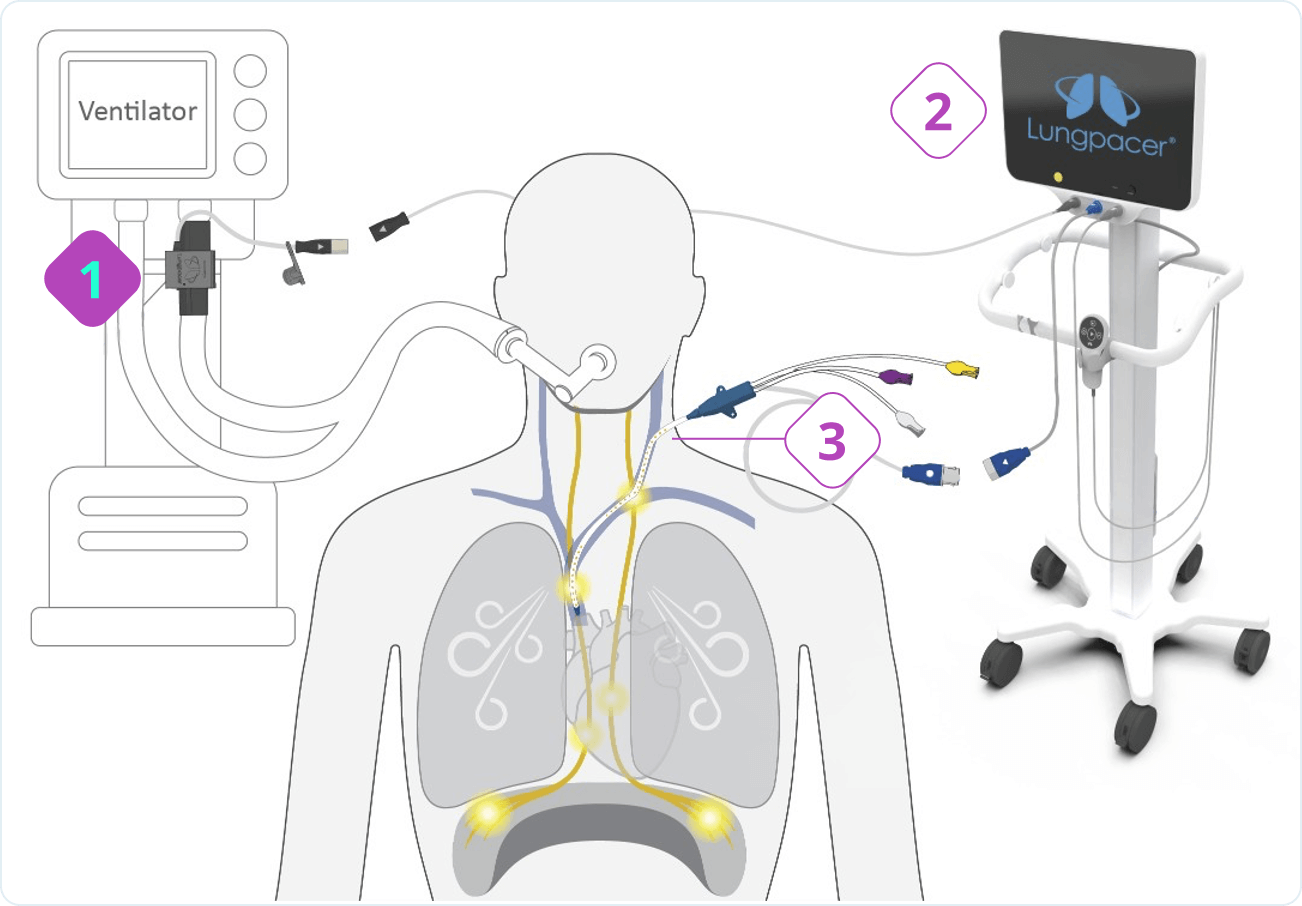
The AeroPace System Comprises
Three Components

1. Airway Pressure Sensor
  • Connects to the inspiratory limb of the ventilator to allow the system to identify ventilator and patient breaths to synchronize and coordinate with stimulation
  • Compatible with any ventilator for single-patient use
2. Neurostimulation Console
  • Intuitive touchscreen system provides continual and intermittent high-intensity TTDN with user-adjustable parameters
  • ECG-guided catheter insertion and placement
  • Simple mapping to select the most effective catheter electrodes
3. Temporary Transvenous Neurostimulation Catheter
  • Temporary transvenous catheter with standard triple lumen CVC functionality
  • Includes 30 specialized electrodes in two arrays that stimulate both phrenic nerves to activate the diaphragm
  • Two sets of 60 stimulations delivered daily

Many ICU Patients May Benefit From AeroPace

The AeroPace® System (a Temporary Transvenous Diaphragm Activation System) is intended for temporary stimulation of the phrenic nerve(s) to increase diaphragmatic strength in mechanically ventilated patients.

The AeroPace System is indicated to improve weaning success – increase weaning, reduce ventilator days, and reduce reintubation – in patients ages 18 years or older on mechanical ventilation ≥ 96 hours and who have not weaned.

AeroPace is not for use with active implanted cardiac pacemakers, defibrillators, or other implantable electronics within proximity to the AeroPace Neurostimulation Catheter.

Frequently Asked Questions (FAQs)

Is the AeroPace system a diaphragmatic pacer?

AeroPace is not a diaphragmatic pacer in the traditional sense. The AeroPace System, the first and only temporary, transvenous diaphragm neurostimulation system for difficult-to-wean patients in the ICU, uses electrical stimulation to activate the phrenic nerves and cause the diaphragm to contract rhythmically during mechanical ventilation. Unlike traditional diaphragmatic pacing devices, AeroPace requires no surgical procedure and no implant. The AeroPace Neurostimulation Catheter is placed at the bedside via the left subclavian vein or left internal jugular vein, similar to a central venous line, and is removed when therapy is complete.

What is the difference between a diaphragmatic pacing system (DPS) and AeroPace therapy?

Diaphragmatic pacing systems are surgically implanted devices designed for long-term or permanent respiratory support in chronically ventilator-dependent patients, typically those with high cervical spinal cord injury. AeroPace, a temporary transvenous diaphragm neurostimulation therapy, is designed for a different patient population: ICU patients on mechanical ventilation who have not weaned after 96 or more hours. The Neurostimulation Catheter is placed transvenously at the bedside without surgery, used up to 30 days, and removed when therapy is complete. In RESCUE-3, the largest randomized controlled trial ever conducted on transvenous diaphragm neurostimulation, patients treated with AeroPace experienced 3 fewer days on the ventilator compared to standard care.

Which nerve stimulates the diaphragm?

The phrenic nerves connect to the diaphragm. The paired phrenic nerves originate at cervical spine levels C3, C4, and C5, travel through the thorax, and innervate the left and right hemidiaphragms. When the phrenic nerves fire, the diaphragm contracts and a breath begins. AeroPace works by delivering electrical stimulation to the phrenic nerves via a temporary transvenous neurostimulation catheter placed at the bedside. AeroPace neurostimulation causes the diaphragm to contract, rebuilding muscle strength during mechanical ventilation. Bilateral phrenic nerve stimulation by AeroPace activates both hemidiaphragms using a single bedside procedure.

What is a diaphragm stimulator?

A diaphragm stimulator is a medical device that delivers electrical impulses to the phrenic nerve or diaphragm to produce muscle contractions and support breathing in mechanically ventilated patients. Diaphragm neurostimulation also may be used to address ventilator-induced diaphragm dysfunction (VIDD): within hours of initiating controlled mechanical ventilation, diaphragm muscle fibers begin to atrophy, which can significantly complicate weaning. AeroPace, a temporary transvenous diaphragm neurostimulation system, functions as a diaphragm stimulator by delivering phrenic nerve stimulation via a transvenous catheter placed at the bedside, with no surgical procedure required. AeroPace is FDA-approved and was awarded a Breakthrough Device Designation by the FDA.

What is a pacemaker for the lungs? How is it different from AeroPace?

“Pacemaker for the lungs” is a colloquial term sometimes used for devices that use electrical stimulation to support breathing in mechanically ventilated patients. AeroPace, a temporary transvenous diaphragm neurostimulation therapy, is distinct in three key ways: (1) it is temporary, (2) placed transvenously at the bedside rather than surgically implanted, and (3) designed specifically for ICU patients on mechanical ventilation who have not weaned, not for long-term or permanent respiratory support. The AeroPace Neurostimulation Catheter is placed via the left subclavian or left internal jugular vein, similar to a central venous line, and removed at the end of therapy. No surgery. No implant.

Is the AeroPace system a phrenic nerve pacer?

AeroPace stimulates the phrenic nerves to activate the diaphragm, but it is not a traditional phrenic nerve pacer. Traditional phrenic nerve pacers are surgically implanted devices for long-term or permanent use in chronically ventilator-dependent patients. AeroPace, a temporary transvenous diaphragm neurostimulation system, applies the same fundamental principle of phrenic nerve stimulation in a temporary, non-surgical, transvenous form. The AeroPace Neurostimulation Catheter is placed at the bedside, used during mechanical ventilation in patients who have not weaned after 96 or more hours, and removed when therapy is complete. In RESCUE-3, AeroPace demonstrated a favorable safety profile consistent with established phrenic nerve stimulation approaches.

References:

1. Dres, M. (2025) Am J Resp Crit Care Med:. doi: 10.1164/rccm.202505-1056OC – Per-protocol (>50% of required stimulations) data for the AeroPace group relative to the Control group. 2. Levine, S. (2008) NEJM; 358(13): 1327-1355. doi: 10.1056/NEJMoa070447; Dres, M. (2017) Am J Respir Crit Care Med; 195(1): 57-66. doi: 10.1164/rccm.201602-0367OC 3. Pu, H. (2023) BMC Pulmonary Medicine; 23(1): 343. doi: 10.1186/s12890-023-02633-y 4. Boles, J.M. et al (2007) Eur Respir J.; 29(5): 1033-1056; doi: 10.1183/09031936.00010206